RAID Log
Keep risks, assumptions, issues and dependencies in one place, each with an owner, a rating and a next step.
Where it fitsStage 5 of 7 · Mobilise: Who does what, and how do we stay in control?
What it is
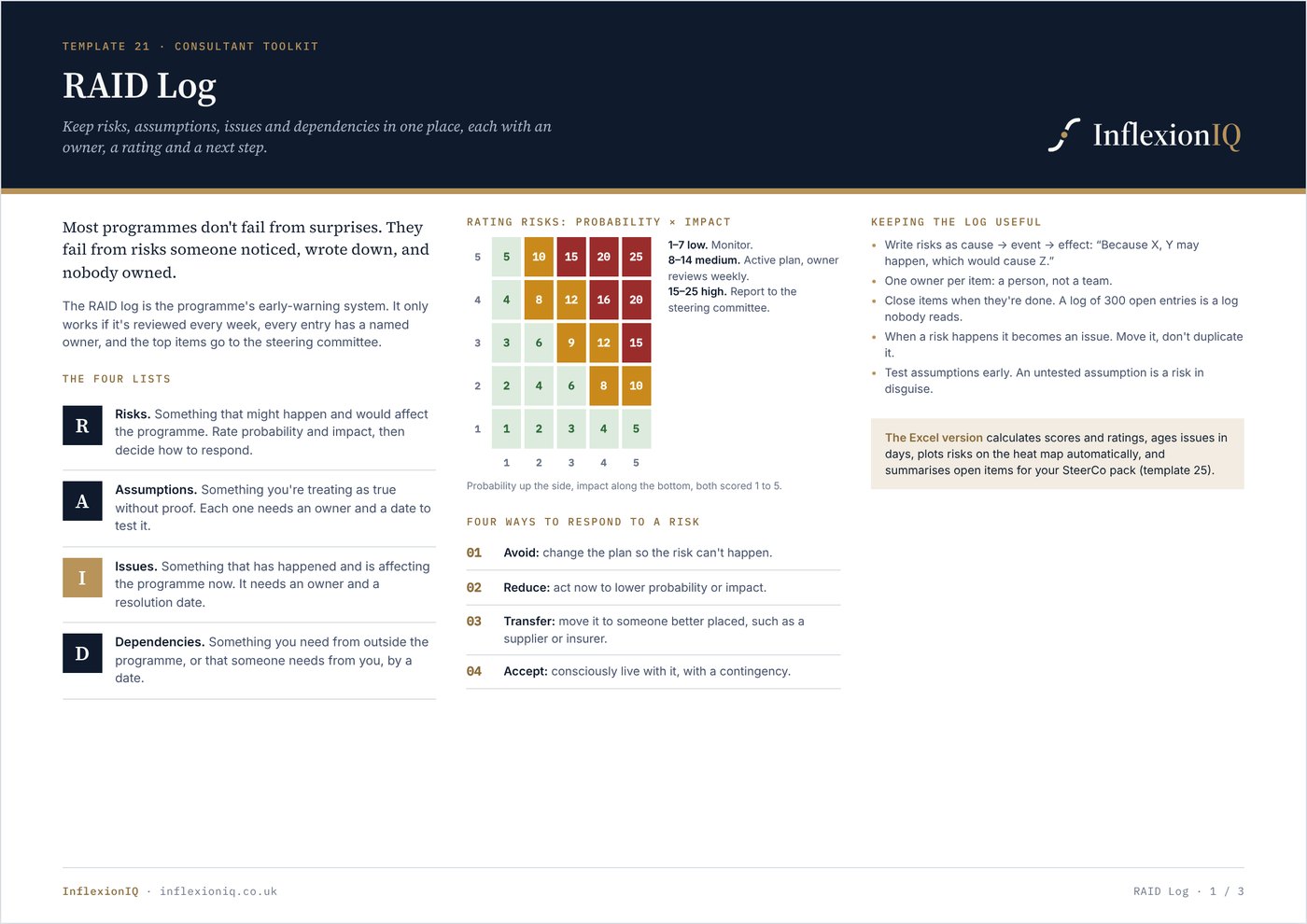
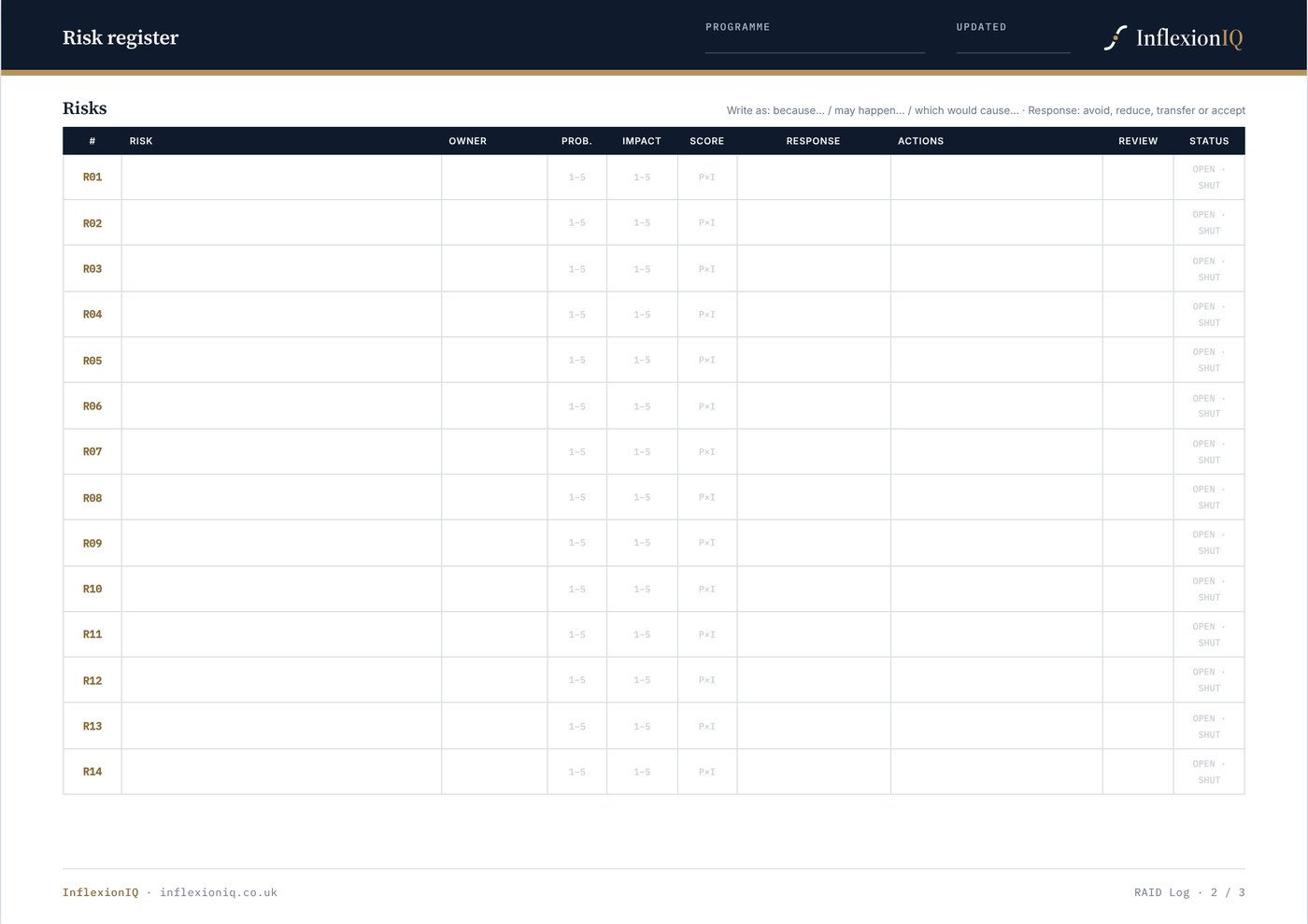
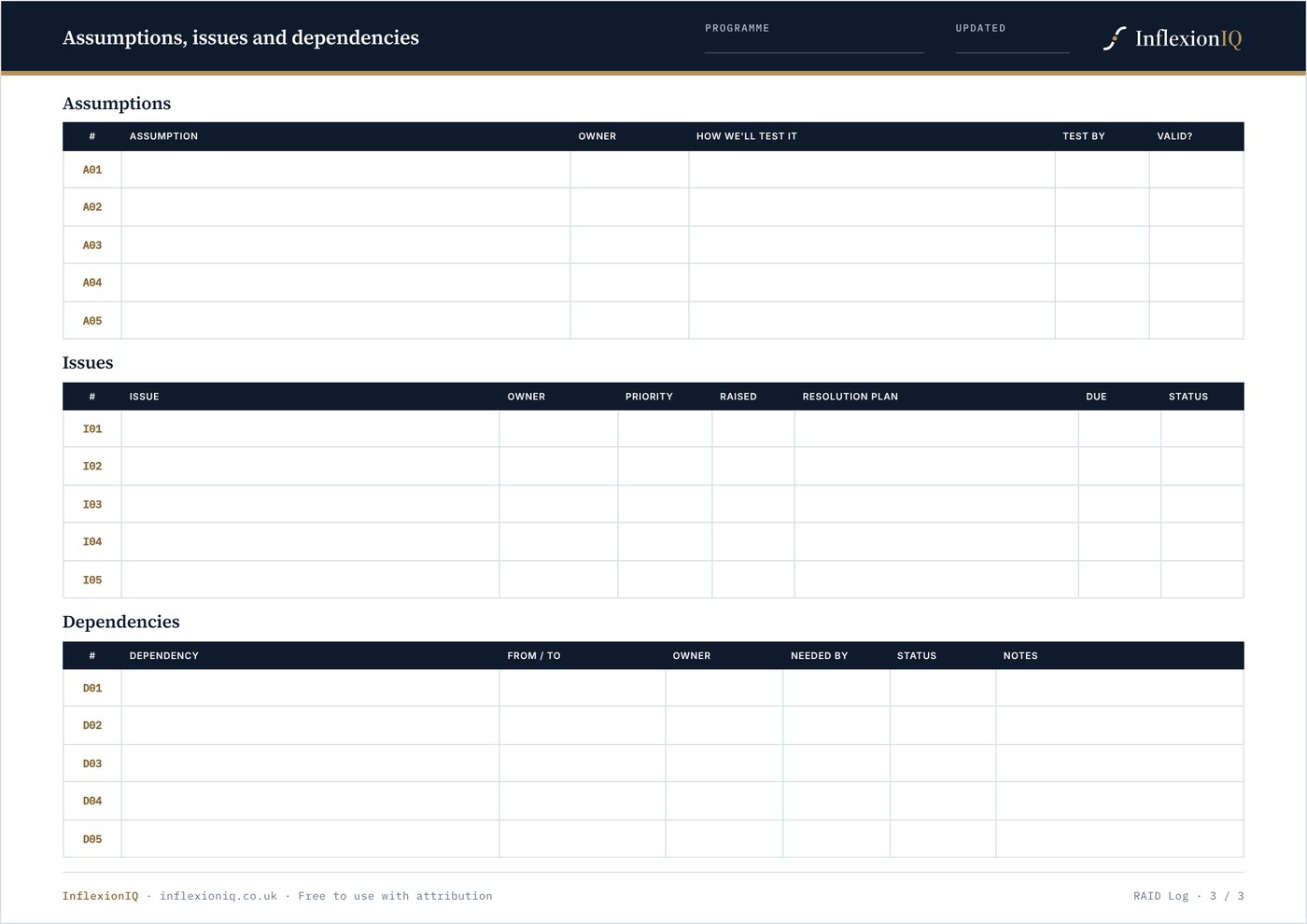
A complete RAID log. The guide explains the four lists, how to score risks on probability and impact, and the four ways to respond. The PowerPoint has a risk register and a page for assumptions, issues and dependencies. The Excel workbook has a sheet for each list, dropdowns and a summary with a heat map that updates as you score.
Why use it
Programmes are rarely caught out by true surprises. More often, someone spotted the risk, wrote it down and nobody owned it. A RAID log with owners, dates and a weekly review is the cheapest early-warning system a programme can have.
How to use it
- Set up the log at mobilisation and agree who maintains it. Usually that is the PMO, but every entry has its own named owner.
- Write each risk as cause, event and effect: because X, Y may happen, which would cause Z.
- Score probability and impact from 1 to 5, and choose a response: avoid, reduce, transfer or accept.
- Give every assumption a date to test it, every issue a resolution date, and every dependency a date it is needed by.
- Review it weekly, close what has done, and take anything scoring 15 or more to the steering committee.
Try it here
Rate a risk's probability and impact from 1 to 5. The score, rating and suggested response update, and the cell lights up on the heat map.
Nothing you enter here leaves your browser. Download the template to keep your work.
When it helps
- Mobilising any programme or project
- Preparing for steering committee meetings
- Taking over a programme and getting a quick view of exposure
- Auditing whether risks are being managed or just recorded
What is inside
- A guide to the four lists, risk scoring and responses
- A risk register, plus assumptions, issues and dependencies pages
- An Excel log with a sheet for each list and dropdowns
- An automatic heat map and summary counts for steering meetings
Worked example
Four entries from the log in the first two months.
| Risk R04 | Because bank statement formats vary widely, the AI may misread income, which could lead to unsuitable lending. Probability 3, impact 5, score 15: goes to the steering committee. Response: reduce, by having an underwriter check every figure during the pilot. Owner: head of underwriting. |
|---|---|
| Assumption A02 | Brokers will upload documents through the new portal rather than by email. Test with three broker firms for four weeks. Owner: broker relationship lead. |
| Issue I01 | The core mortgage system's interface will not be ready until the third quarter. A temporary file transfer is being built. Owner: IT lead. |
| Dependency D01 | The open banking provider's contract must be signed by 1 March to keep the pilot on time. Owner: procurement. |
What happened next. R04 was watched weekly. When the accuracy test showed 88%, the team was already prepared to pivot.
Preview
Questions
What is the difference between a risk and an issue?
A risk might happen in the future. An issue has already happened and is affecting the programme now. When a risk occurs, close it and open an issue.
How often should a RAID log be reviewed?
Weekly by the programme team, with the top risks and any overdue issues going to the steering committee every time it meets.
Rate and review
How useful was this template?
Your rating and comments help me improve the template and decide what to build next. It takes less than a minute.
Thank you.
Your feedback has been sent. If you have got another minute, share the template with someone who'd find it useful.
More templates
All templates →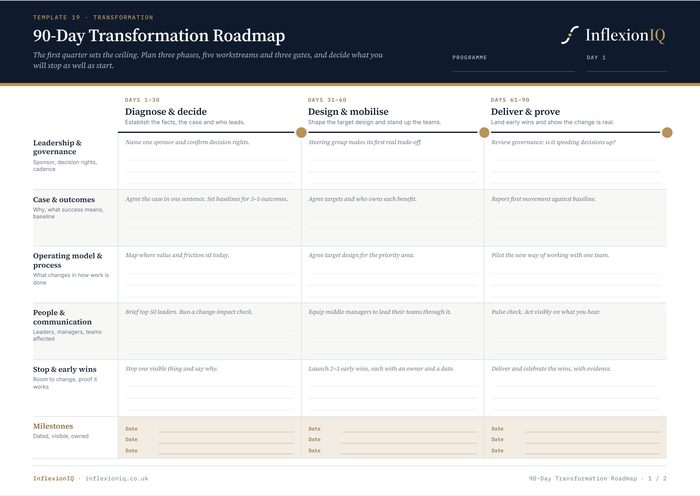
90-Day Transformation Roadmap
Plan the first quarter of a change programme across five workstreams, with three gates that force real decisions. PowerPointPDFView and download →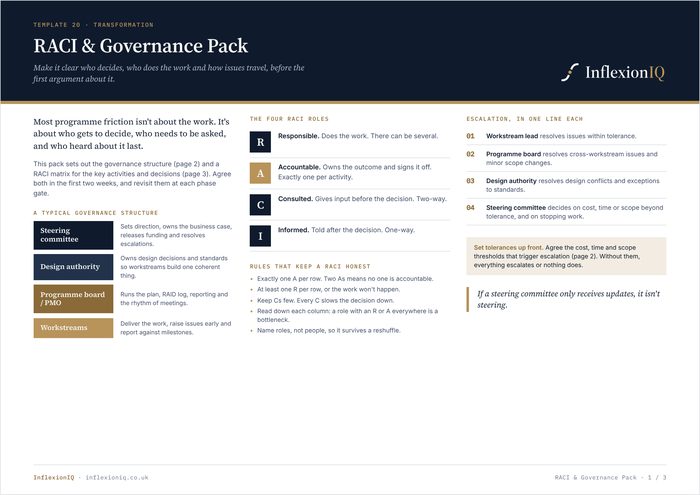
RACI & Governance Pack
Make it clear who decides, who does the work and how issues travel, before the first argument about it. PowerPointExcelPDFView and download →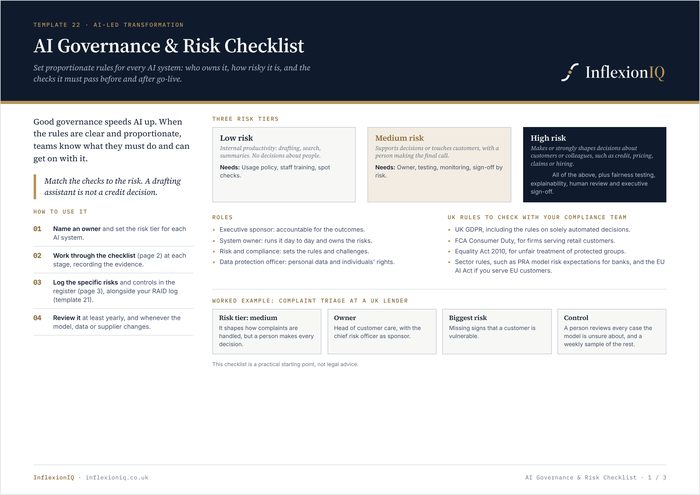
AI Governance & Risk Checklist
Set proportionate rules for every AI system, covering who owns it, how risky it is, and the checks it must pass before and after go-live. ExcelPowerPointPDFView and download →Need something different? Request a template →