Business Model Canvas
Nine building blocks that show how an organisation creates, delivers and captures value, on a single page.
Where it fitsStage 2 of 7 · Strategise: Where are we going, and how will we win?
What it is
My branded version of the Business Model Canvas. A guide page explains the nine blocks, gives the questions to ask in each and sets out the order to fill them in. It ends with four stress tests. The second page is the canvas itself, ready to fill in for today's model or a future one.
Why use it
Strategy documents describe ambitions. A business model shows the mechanics: who pays, for what, through which channels, and what it costs to deliver. Drawing today's model next to tomorrow's makes the size of a transformation visible, and shows which blocks have to change first.
How to use it
- Start on the right of the canvas with customer segments and value propositions, then channels, relationships and revenue streams.
- Move to the left with key resources, activities and partners, and finish with the cost structure.
- Draw today's model first, honestly. Then draw the future model on a second copy.
- Circle the blocks that change most between the two. Those are where the transformation has to start.
- Run the four stress tests on the future model before you commit to it.
When it helps
- Stress-testing the current model before a transformation
- Designing a new venture, product line or service
- Comparing your model with a competitor's or a new entrant's
- Aligning a leadership team on how the business actually works
What is inside
- Guide to the nine blocks, with three questions for each
- The order to fill them in, starting with customers and value
- Four stress tests, including the weakest block and the copycat test
- A full canvas with Today and Future options
Worked example
Two canvases showed the board how far the business model had to move.
| Value proposition | Today: a trusted lender for complex incomes, if you can wait. Future: the same expertise, with a decision in days. |
|---|---|
| Channels | Today: brokers by email and phone, plus branches. Future: a broker portal with live case status. |
| Key activities | Today: manual document checks and underwriting. Future: AI reads documents, underwriters focus on judgement. |
| Customer relationships | Today: little contact after completion. Future: proactive offers before fixed rates end. |
| Cost structure | Today: processing staff and legacy systems. Future: fewer manual steps and a shared data platform. |
What happened next. The canvas made it clear that speed was a business model choice as much as an IT project.
Preview
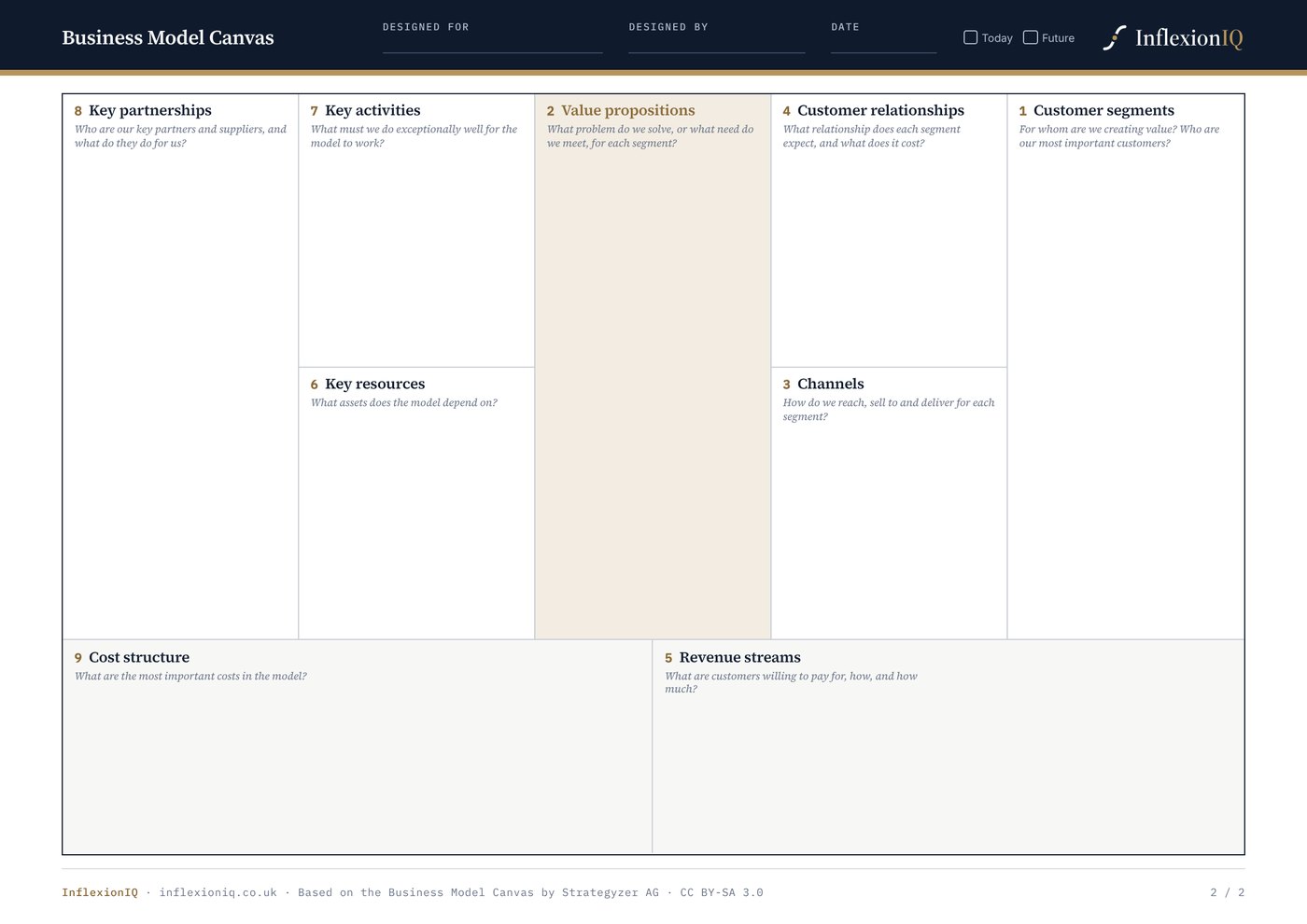
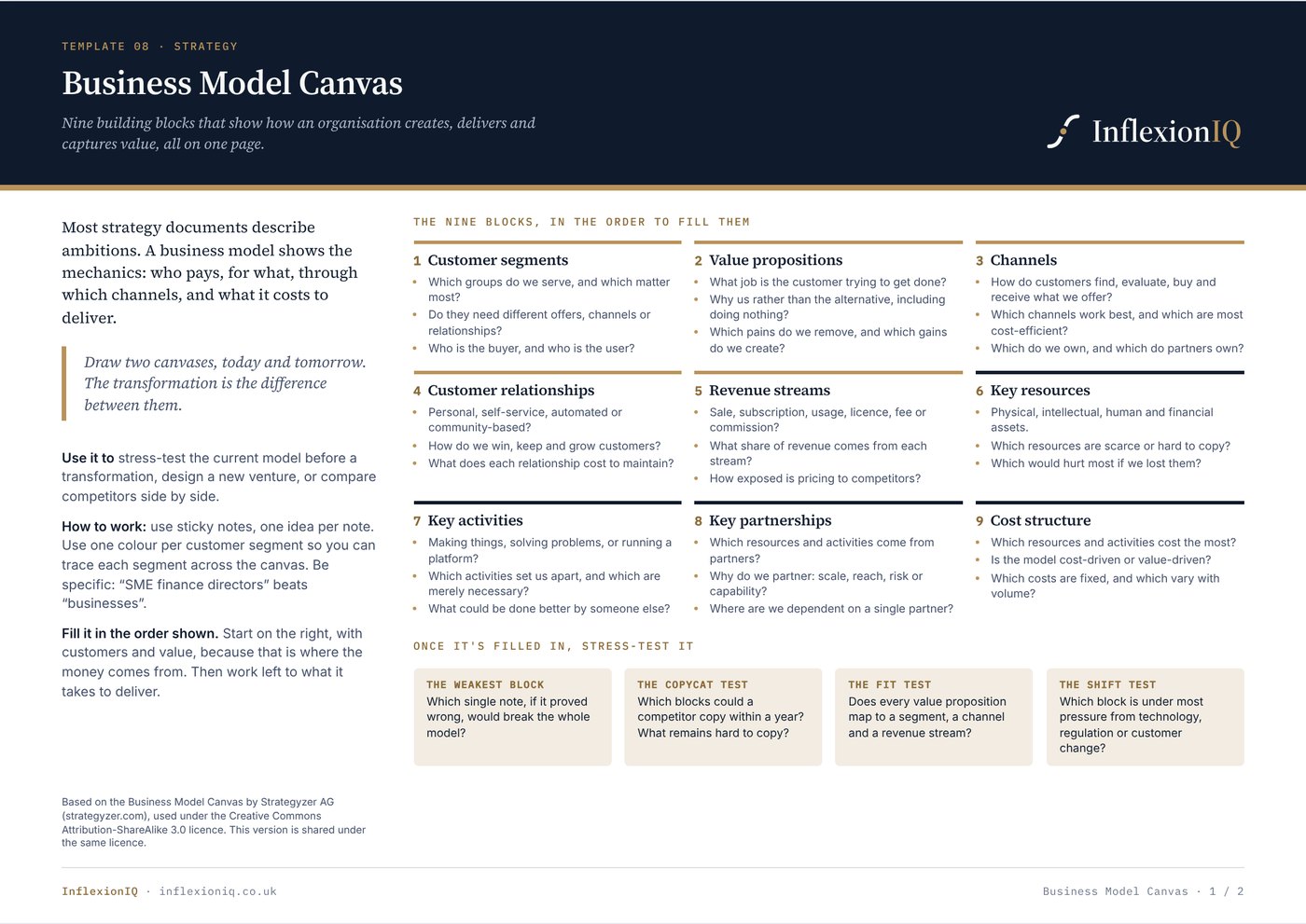
Based on the Business Model Canvas by Strategyzer AG (strategyzer.com), used and shared under the Creative Commons Attribution-ShareAlike 3.0 licence.
Questions
What are the nine blocks of the Business Model Canvas?
Customer segments, value propositions, channels, customer relationships, revenue streams, key resources, key activities, key partnerships and cost structure.
In what order should you fill in a Business Model Canvas?
Start on the right with customer segments and value propositions, then channels, relationships and revenue streams. Then work left to key resources, activities, partnerships and finally costs.
Rate and review
How useful was this template?
Your rating and comments help me improve the template and decide what to build next. It takes less than a minute.
Thank you.
Your feedback has been sent. If you have got another minute, share the template with someone who'd find it useful.
More templates
All templates →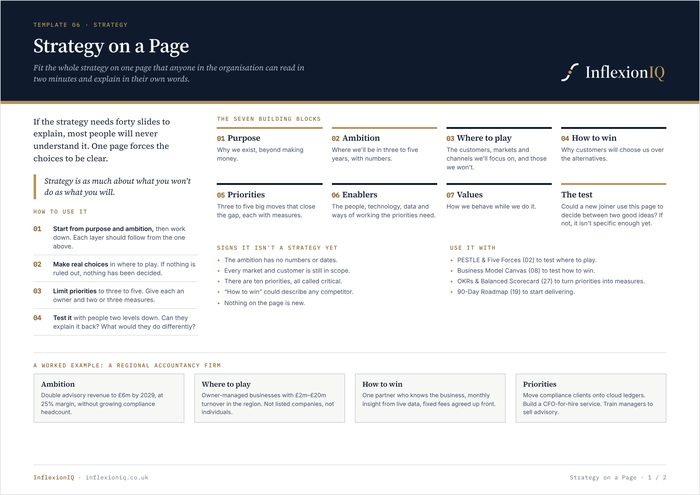
Strategy on a Page
Fit the whole strategy on one page that anyone in the organisation can read in two minutes and explain in their own words. PowerPointPDFView and download →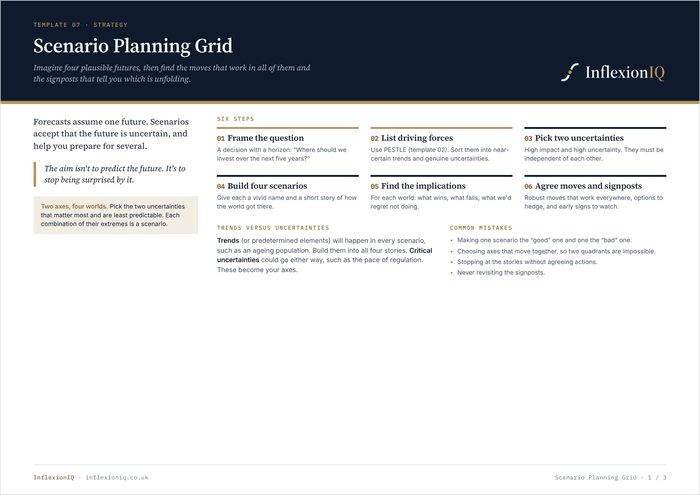
Scenario Planning Grid
Imagine four plausible futures, then find the moves that work in all of them and the signposts that tell you which is unfolding. PowerPointPDFView and download →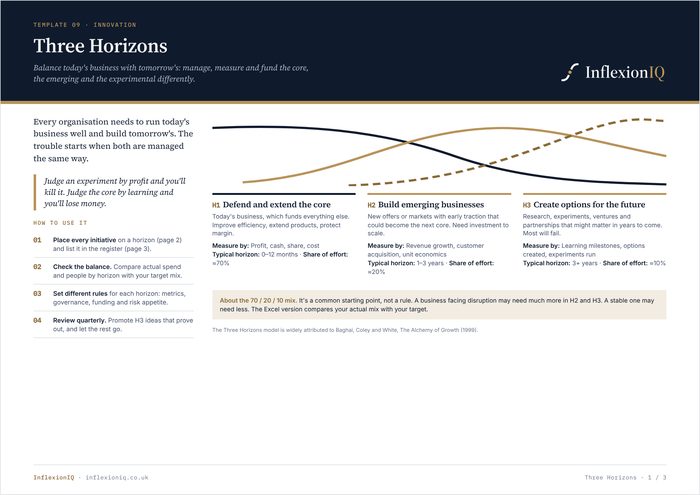
Three Horizons
Balance today's business with tomorrow's, and manage, measure and fund the core, the emerging and the experimental differently. PowerPointExcelPDFView and download →Need something different? Request a template →